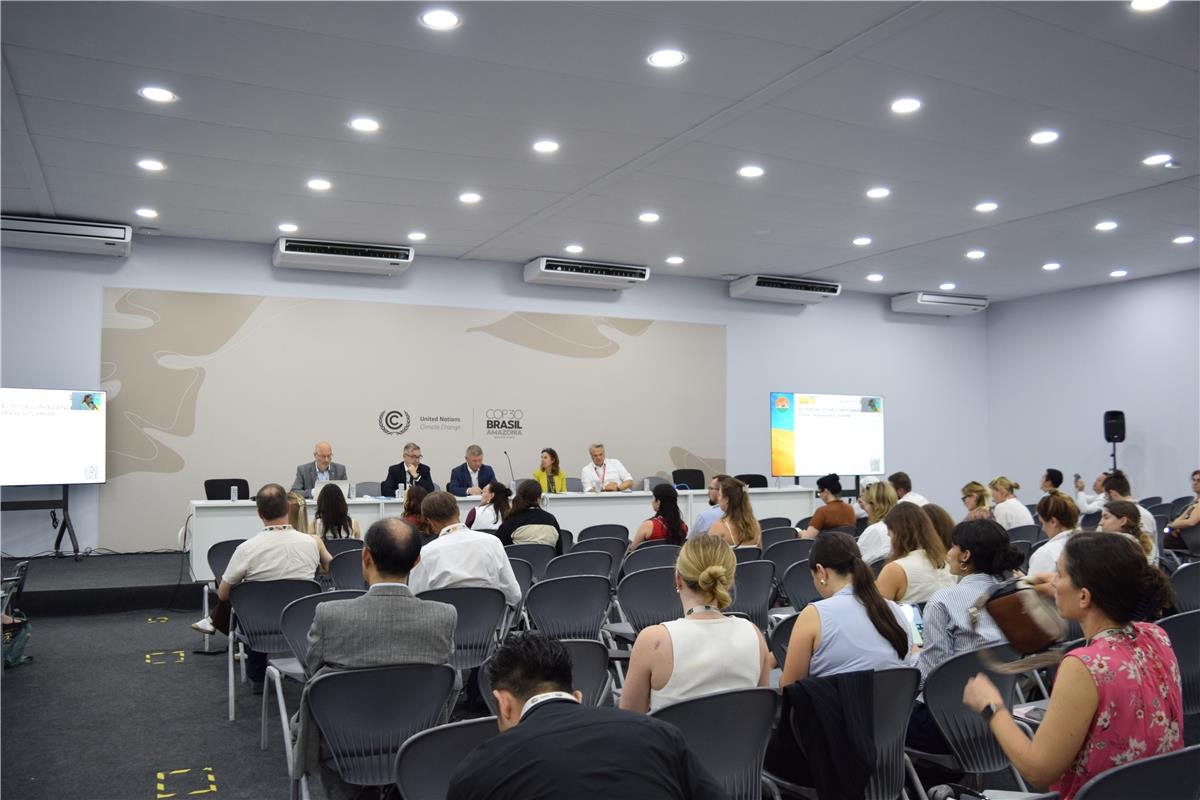
At the 30th Conference of the Parties to the UN Framework Convention on Climate Change (COP30), held from 10 to 21 November in Brazil, more than 30 events took place in the Ukrainian Pavilion with the participation of government officials, diplomats, scientists, business representatives and civil society.
On behalf of the Minister of Economy, Environment and Agriculture of Ukraine Oleksii Sobolev, the national statement – a mandatory and highly responsible element of the conference – was delivered by Deputy Minister Pavlo Kartashov. The statement addressed the environmental damage caused by russia’s full-scale aggression not only to Ukraine but far beyond its borders.
Ukraine brought several important results of its climate work to COP30:
• adoption of the second Nationally Determined Contribution, which sets an ambitious target to reduce emissions by more than 65% by 2035,
• submission of the Biennial Transparency Report under the Paris Agreement,
• presentation of the Long-Term Low-Emission Development Strategy (this document will be officially adopted soon and will guide Ukraine’s green transition and recovery).
In addition, during the conference the Deputy Minister held around 20 bilateral meetings with representatives of EU governments, Canada, Japan, the United Kingdom, and international organisations, expressing Ukraine’s gratitude for their continued support. The meetings covered cooperation in renewable energy, decarbonisation, water resources, waste management, biodiversity, and green recovery.
“Climate and environment have no borders. The severe pollution caused by russia’s war – especially over the past four years – already affects both our country and places far beyond our borders. Despite this, Ukraine remains committed to its international environmental obligations and demonstrated this once again at the UN Climate Change Conference COP30 in Brazil,” noted Deputy Minister Pavlo Kartashov.
European partners highlighted Ukraine’s progress, including the adoption of the framework climate law, the commitment to climate neutrality by 2050, and the preparation of an action plan for the Emissions Trading System.
“I am deeply impressed by how Ukraine, even in the conditions of full-scale war, is simultaneously taking steps that also contribute to combating climate change. When you decentralize your energy system and increase the share of renewables, these steps strengthen resilience – and are an investment in Ukraine’s future,” said EU Commissioner for Energy Dan Jørgensen.
Nearly every discussion in the Ukrainian Pavilion addressed the scale of environmental and climate damage that russia is already inflicting on the world, as well as Ukraine’s post-war recovery.
“We must ensure that the recovery truly follows the build back better principle – rebuilding better than before. This means restoring the country in a way that lays the foundations of a clean economy. Instead of reconstructing outdated and high-carbon assets, Ukraine has the chance to leap directly into a modern low-carbon industrial base – investing in green steel, hydrogen and sustainable construction materials. If the recovery is genuinely green, it will not only reduce emissions and restore ecosystems but also secure Ukraine’s place in the European economy,” said Estonia’s Deputy Minister for Climate Kristi Klaas.
One of the key presentations was the launch of Europe’s first national standard for eco-industrial parks, presented by the Ministry of Economy, Environment and Agriculture of Ukraine. The standard is harmonised with the UNIDO framework and creates new rules for establishing modern industrial sites that support sustainable development and green recovery.
“Today Ukraine needs not just investment, but capital that aligns with ESG principles. Eco-industrial parks offer exactly these conditions: transparent governance, modern infrastructure, and environmental standards. This makes Ukraine an attractive and responsible destination for investors,” emphasized Deputy Minister Vitalii Kindrativ.
A separate COP30 discussion focused on the impact of the war on Ukrainian soils. The war has already destroyed millions of hectares of agricultural land. Burned soil loses organic matter – carbon is released into the atmosphere, and land loses its capacity to capture and store it. Hostilities also cause erosion and risks of spreading contaminants to fertile fields. Additional threats include heavy metals and toxic residues from explosives.
“We are the first country in Europe to face contamination on this scale. Ukraine is working on developing an internationally recognised soil sampling methodology, expanding laboratory capacity, and building risk models for contaminant transfer into agricultural products. To bring life back to these lands, we need international support,” stressed Deputy Minister Ihor Bezkaravainyi.
The Ukrainian delegation also took part in events outside the pavilion, including discussions on compensation for climate damage caused by russia’s aggression. The IGGAW initiative estimated wartime emissions at 236.8 million tonnes of CO₂-equivalent and damage at USD 43.8 billion.
Despite the war, Ukraine remains among the countries that are introducing new sustainability standards, modernising industry, and shaping approaches to green recovery. COP30 confirmed that Ukraine is an active participant in global climate policy and a reliable partner on the path to a climate-neutral future.
Reference
COP30 (Conference of the Parties 30) is the 30th session of the UNFCCC, the world’s main annual climate event.
This year, Ukraine hosted its national pavilion for the fourth time, once again drawing attention to the long-term environmental consequences of russia’s aggression. Environmental losses are already estimated at nearly 6 trillion UAH, and more than 3 million hectares of forests have been destroyed.
Key themes of COP30 included climate finance, the gradual phase-out of fossil fuels, renewable energy development, and the protection of forests and biodiversity.