At URC 2026, humanitarian demining was presented as a сornerstone for investment and Ukraine's economic recovery
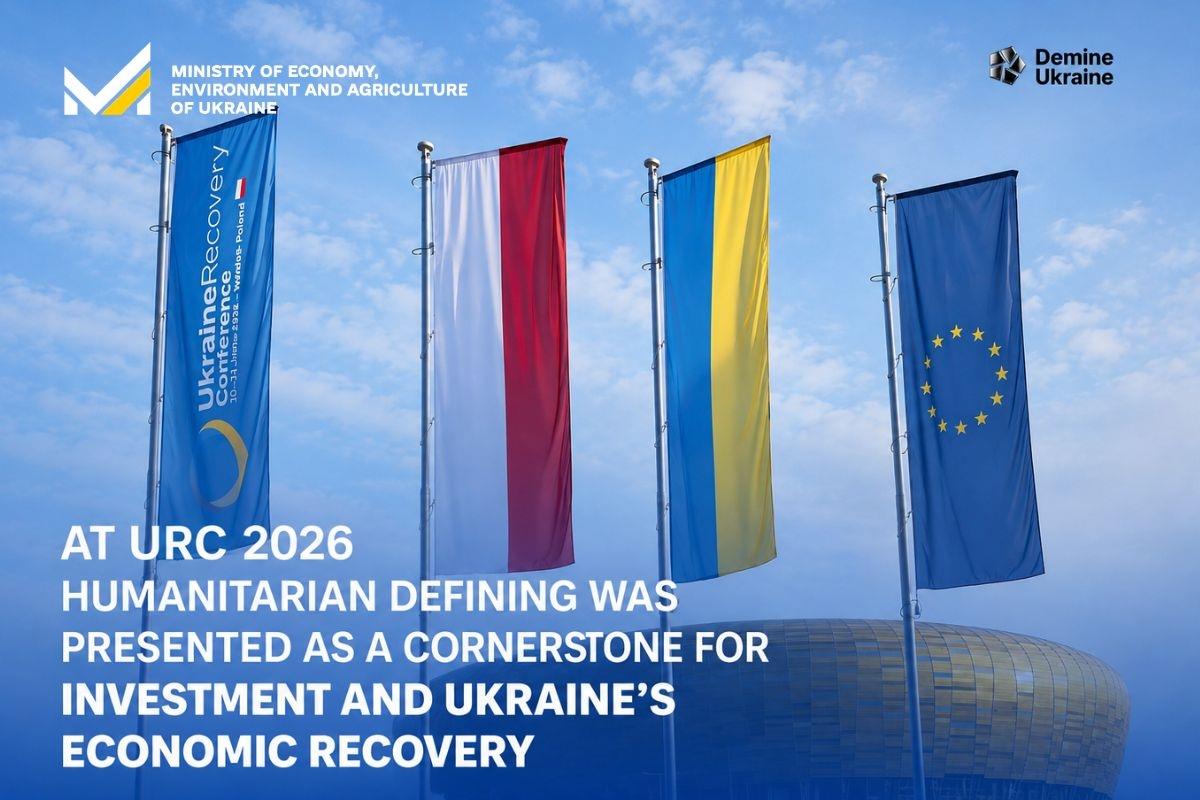
Representatives of international financial institutions, donor organisations, humanitarian demining operators, businesses, and the Government of Ukraine discussed how to integrate humanitarian demining into recovery programmes, attract a broader range of investors, and develop financing mechanisms to accelerate the return of land to safe use.
These issues were at the centre of the closed-door discussion Safe Ground, New Markets: Clearing the Way for Ukraine's Recovery, organised by Minderoo Foundation and The HALO Trust during the Ukraine Recovery Conference 2026.
Opening the discussion, Deputy Minister of Economy, Environment and Agriculture of Ukraine Ihor Bezkaravainyi stressed: "Every investment decision begins with one question: is this place safe enough to invest in? Humanitarian demining must be integrated into recovery planning from the very beginning. If land is not cleared, no recovery project can begin. In Ukraine, we are building a competitive humanitarian demining market, fostering competition, testing new financing models, and creating the conditions for private capital to become part of the sector."
Ukraine is already putting this approach into practice. More than 133,000 km² of Ukrainian territory remains potentially affected by explosive ordnance. As a result, the Government is prioritising the clearance of areas where returning land to use delivers the greatest economic impact. This includes applying a prioritisation system and implementing the state compensation programme for agricultural land clearance, which has already returned more than 16,000 hectares of farmland to farmers.
Participants emphasised that scaling up humanitarian demining will require a different approach to financing — integrating clearance as the first stage of investment projects, community development initiatives, and economic recovery programmes, rather than relying solely on increasing donor funding.
The discussion also highlighted the barriers that continue to limit investment in the sector, including ongoing hostilities, and competition between humanitarian demining and other humanitarian priorities.
At the same time, participants agreed that humanitarian demining is what enables investment in agriculture, infrastructure, manufacturing, and local economic development. As a result, demining should become an integral part of Ukraine's recovery programmes, with greater involvement from international financial institutions, private investors, and philanthropic organisations.
Bruce Edwards, Head of Partnerships at The HALO Trust, stressed that humanitarian demining should be viewed as the first stage of the investment cycle rather than as a standalone humanitarian activity. "Demining is only one part of the task, but it is the fundamental one. Recovery and investment can only follow once land has been cleared, giving investors confidence in what comes next," he said.
Participants also discussed the development of new financing mechanisms, including front-loading and outcome-based financing, which could accelerate land clearance while making investment in the sector more predictable.
Concluding the discussion, participants agreed to continue developing practical financing models for humanitarian demining and to strengthen partnerships between governments, donors, financial institutions, operators, and businesses. The next opportunity to advance this work will be the UMAC conference, which will take place in Brussels this November.